Fiber is good… but more isn't always better
Here's one of the biggest mistakes I see.
You hear "fiber feeds your good bacteria." So you suddenly start eating all of this at once:
- Huge salads
- Beans
- Lentils
- Broccoli
- Cauliflower
- Chia seeds
- Flax
- Resistant starch
- Prebiotic powders
- 30+ plants a week
Then your stomach blows up. And you're shocked.
This doesn't mean fiber is bad. Your gut may just not be ready for that amount, or that type, of fiber yet.
Think about fiber like exercise.
If you haven't worked out in two years, you wouldn't walk into the gym and do a two-hour leg day. You'd be destroyed.
You build up the workload as your body adapts. Your gut works the same way.
Why fiber can make bloating worse at first
Your digestive enzymes can't fully break down many fibers. So some of that fiber reaches your colon, where your gut microbes ferment it.
That fermentation can be a good thing. But it also creates gas.
If you have a sensitive gut, constipation, IBS, slow motility, or significant dysbiosis, a lot of fermentation at once can mean a lot more symptoms.
That's why you can eat a "healthy" high-fiber meal and feel terrible afterward.
It doesn't necessarily mean "my body can't tolerate fiber."
It may simply mean: that was more fermentation than my gut can handle right now.
Fibers that ferment quickly, like some of the carbohydrates found in high-FODMAP foods, tend to build up gas fast. Slower-fermenting fibers are usually easier to tolerate.
Not all fiber is the same
Here's what I want you to understand most.
People talk about fiber like it's one nutrient. It isn't. Different fibers behave completely differently in your digestive tract.
You can think of them on a spectrum:
- GentlerSlower or minimally fermented
- ModerateModerately fermented
- More fermentableHighly fermentable and prebiotic fibers
More fermentable doesn't mean bad. It simply means we may need to introduce these fibers more gradually if your gut is sensitive.
For example, psyllium tends to create far less gas than fast-fermenting fibers like inulin, FOS, and GOS. Those, along with wheat bran, can make gas-related symptoms worse for some people.
If your gut is very sensitive, start at the gentle end of the spectrum.
The goal isn't zero fermentation
The goal isn't to avoid fermentation forever.
Fermentation is one of the reasons fiber is so good for you. Your microbes turn certain fibers into helpful compounds, like short-chain fatty acids.
So the goal is not "eliminate anything that feeds bacteria."
The goal is to control how much fermentation you're creating, while slowly increasing how much your gut can tolerate.
- Start gentle
- Build tolerance
- Increase diversity
Level 1: Start gentle
To make this simple, we're going to use a 3-level Fiber Ladder.
- Level 1 · Start gentle
- Level 2 · Build fermentation
- Level 3 · Diversify
Start here.
Start gentle
Low-FODMAP portions and gentler, slower-fermenting fibers.
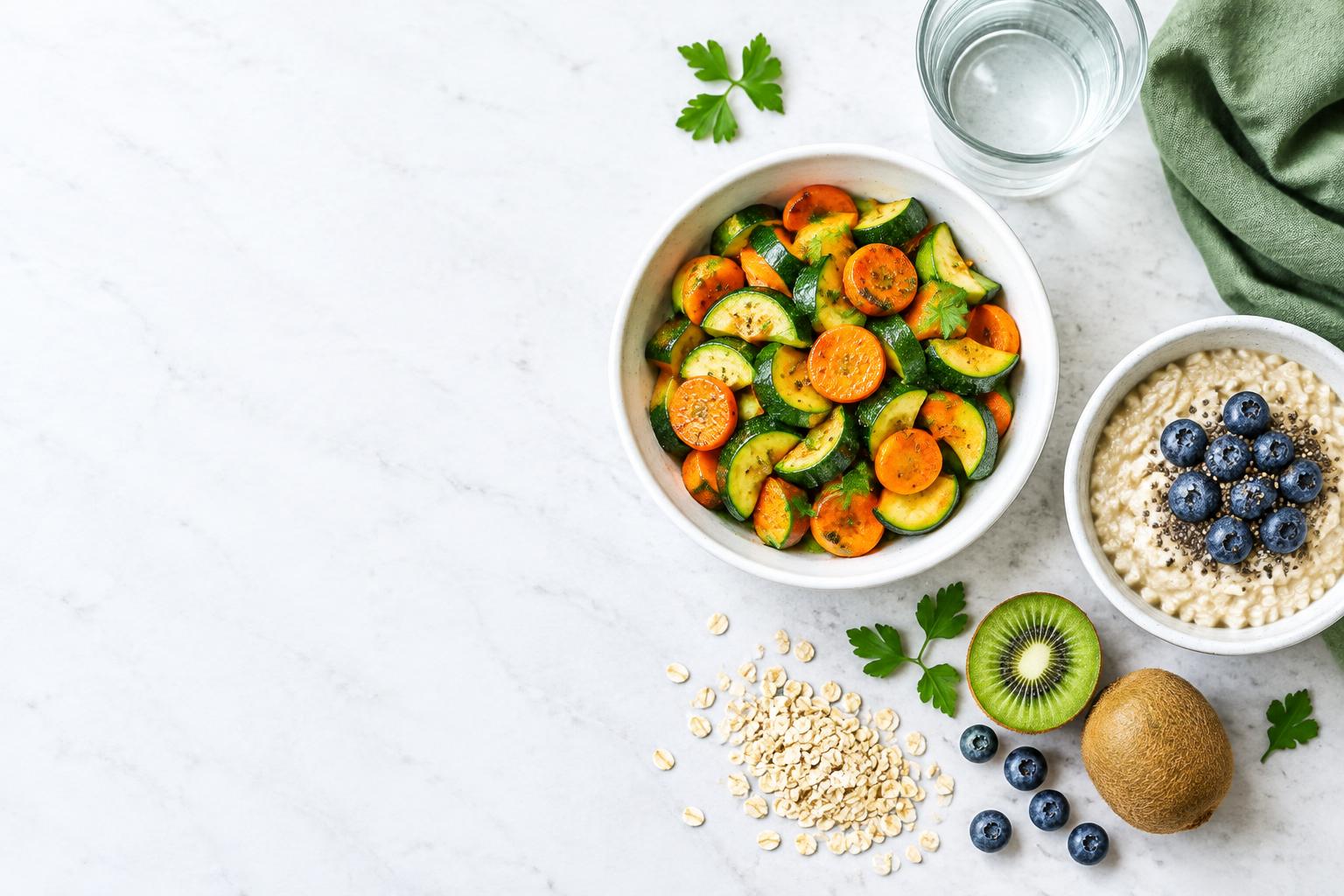
- Carrots
- Zucchini
- Green beans
- Eggplant
- Kiwi
- Citrus
- Berries
- Firm banana, if tolerated
- Oats
- Rice
- Quinoa
- Potatoes
- Psyllium, when appropriate
GoalIntroduce fiber without overwhelming your gut.
At this level, look for fibers that are low FODMAP at the portion you're eating, slower fermenting, easy to digest, and not huge in volume.
Psyllium is especially helpful. It forms a gel and ferments slowly, which is why it's usually a better choice for IBS than coarse fibers like wheat bran.
Portions still matter. A food can be low FODMAP in a small serving and high FODMAP in a big one.
Level 2: Build fermentation
Once you're tolerating Level 1 well, move to the next level.
That doesn't mean jumping straight to unlimited beans and prebiotics. It means slowly adding fibers that are a bit more fermentable.
Build fermentation
Gradually introduce more fermentable fibers while controlling the dose.
- More oats
- Seeds
- Greater fruit variety
- Greater vegetable variety
- Resistant starch
- Small amounts of legumes, if tolerated
GoalGive your microbiome more food and variety without dramatically increasing symptoms.
Resistant starch is a good example. It's fermentable, but it ferments more slowly through the colon than fast fibers like FOS or GOS.
More variety, same careful dose.
Level 3: Diversify
Eventually, the goal is a diverse diet. Not a permanently restrictive one.
Diversify
Gradually challenge more fermentable and prebiotic foods.
- Beans
- Lentils
- Cruciferous vegetables
- Onion
- Garlic
- Larger servings
- Higher-FODMAP fruits
- Resistant starches
- Prebiotic fibers
GoalBuild toward a broad, diverse diet instead of staying restrictive forever.
Not all at once. One step at a time.
This is also why low FODMAP isn't the final destination. It works best as a short-term phase, followed by reintroducing foods and personalizing your diet over time.
Restriction controls symptoms. Diversity rebuilds resilience.
You just have to work your way back to diversity gradually.
Restriction is the starting point. Diversity is the destination.
How fast should you increase fiber?
Here's how to put this into practice.
Forget "you need 30 grams of fiber." Start by finding your current baseline.
Let's say you're eating around 10–12 grams a day right now. Don't jump to 30 grams tomorrow. Instead, build up over time. For example:
- 10g
- 12g
- 14g
- 16g
- 18g…
This is an example, not a rigid prescription. There's no magic number you need to increase by. The point is to make small increases your gut can comfortably adapt to.
Instead of changing your whole diet overnight, increase one food, one serving, or one fiber source at a time. If you're sensitive, that might mean one small change every several days.
Many adults eventually do well around 25–30 grams a day or more. But your tolerance and needs matter.
Your gut doesn't need a massive increase. It needs an amount it can adapt to.
Change one thing at a time
Another huge mistake. On Monday, you start all of this:
- Psyllium
- Chia
- Probiotics
- Magnesium
- Sauerkraut
- Resistant starch
- Beans
- Three new vegetables
By Tuesday you're incredibly bloated. And now we have absolutely no idea what caused it. 😂
Instead, introduce one thing. Keep everything else about the same. Watch how you feel. Then progress.
- Days 1–3
- Small amount
- Days 4–6
- Increase slightly
- Days 7–10
- Increase again if tolerated
You don't have to use those exact days. What matters is the rhythm:
Portion size matters as much as the food
You might tolerate ¼ cup of something, but not 2 cups of it.
That doesn't automatically mean you're intolerant to that food. It means you found your current threshold.
This matters a lot with FODMAPs. Foods aren't simply "low FODMAP" or "high FODMAP." The serving size changes the answer.
- Instead of asking
- Can I eat this food: yes or no?
- Ask
- What's the amount I tolerate right now?
The food may not be the problem. The dose may be the problem.
Cook your plants at first
If you're very sensitive, a giant raw salad isn't the place to start.
Cooking makes plant foods softer and often easier to handle.
- Cooked carrots
- over a giant raw carrot salad
- Cooked zucchini
- over a mountain of raw vegetables
- Cooked potato
- over a big bowl of raw cruciferous veggies
You're still getting plant fiber. You're just making digestion a little easier. Later, you can expand texture and variety.
Don't "fiber stack"
Another easy way to accidentally overwhelm your gut is fiber stacking.
Picture a day like this:
- Breakfast
- Oats + chia + berries
- Lunch
- Large salad + avocado
- Snack
- Apple + nuts
- Dinner
- Beans + broccoli + sweet potato
- Dessert
- Prebiotic protein bar
Each individual food may be fine on its own. But when you stack highly fermentable foods across the entire day, your total fermentation load can exceed what your gut currently tolerates.
By nighttime: 🎈🎈🎈 You look six months pregnant with a food baby.
Don't try to cram your whole day's fiber into one meal.
Be careful with "gut health" products
This one is sneaky. You start trying to heal your gut and buy:
- Prebiotic greens powder
- Fiber gummies
- Gut health bars
- Prebiotic soda
- Prebiotic protein powder
- Inulin powder
Meanwhile, you're wondering why you're farting roughly 400 times a day. 😂
Check the ingredients. These are the common highly fermentable additions:
- Inulin
- Chicory root fiber
- FOS
- GOS
These ingredients aren't bad. They're prebiotics. But if you're already extremely bloated, adding a large dose of highly fermentable prebiotic fiber may make symptoms significantly worse.
A prebiotic can be healthy and still be the wrong choice for your gut right now.
Don't forget motility
Fiber can't fix every constipation problem.
If traffic is already backed up, adding more cars doesn't solve the traffic jam.
If you're severely constipated, simply piling more fiber into your digestive tract may make you feel even more bloated.
So before you push fiber higher, think about these too:
- Bowel movement frequency
- Complete evacuation
- Hydration
- Movement
- Meal spacing
- Medications & supplements
- Pelvic floor function
- Overall motility
Fiber is one tool. It isn't the entire constipation solution.
Drink enough fluid
As your fiber goes up, fluid matters too. Especially with gel-forming fibers like psyllium.
But this doesn't mean "drink a gallon of water to poop." More isn't always better here either.
Just stay well hydrated as you build up.
Some symptoms don't mean you failed
This is a helpful mindset shift.
If you add more fermentable foods and notice a little more gas, but otherwise feel comfortable, that doesn't mean "STOP. Your gut hates this food." Fermentation naturally creates some gas.
- Significant pain
- Severe distension
- Major bowel changes
- Symptoms lasting hours or days
We're not expecting absolutely zero digestive sensation. We're also not trying to push through severe symptoms.
You don't want to be curled up in the fetal position because TikTok told you to eat 40 plants this week. We're looking for the middle. 😂
The Fiber Ladder, step by step
Here's the whole training in seven steps.
- 1Start gentle
Choose low-FODMAP portions and gentler fibers.
- 2Start small
Avoid massive jumps in fiber intake.
- 3Change one thing
Introduce one new variable at a time.
- 4Let your gut adapt
Stay there until symptoms are manageable.
- 5Build the dose
Slowly increase serving sizes.
- 6Build the variety
Introduce more plant foods and fermentable fibers.
- 7Personalize
Build the most diverse diet your gut comfortably tolerates.
7 mistakes that make fiber bloating worse
- 1Going from 0 to 100 overnight
- 2Thinking all fiber behaves the same
- 3Starting with highly fermentable fibers
- 4Eating enormous portions of "healthy" foods
- 5Introducing five new things at once
- 6Staying low FODMAP forever
- 7Pushing fiber while severely constipated, without addressing why